Untap · Journal · 2 May 2026
Worth a Letter
UK drivers receive 23 million parking tickets a year. The system favours the ones who appeal. Almost nobody does
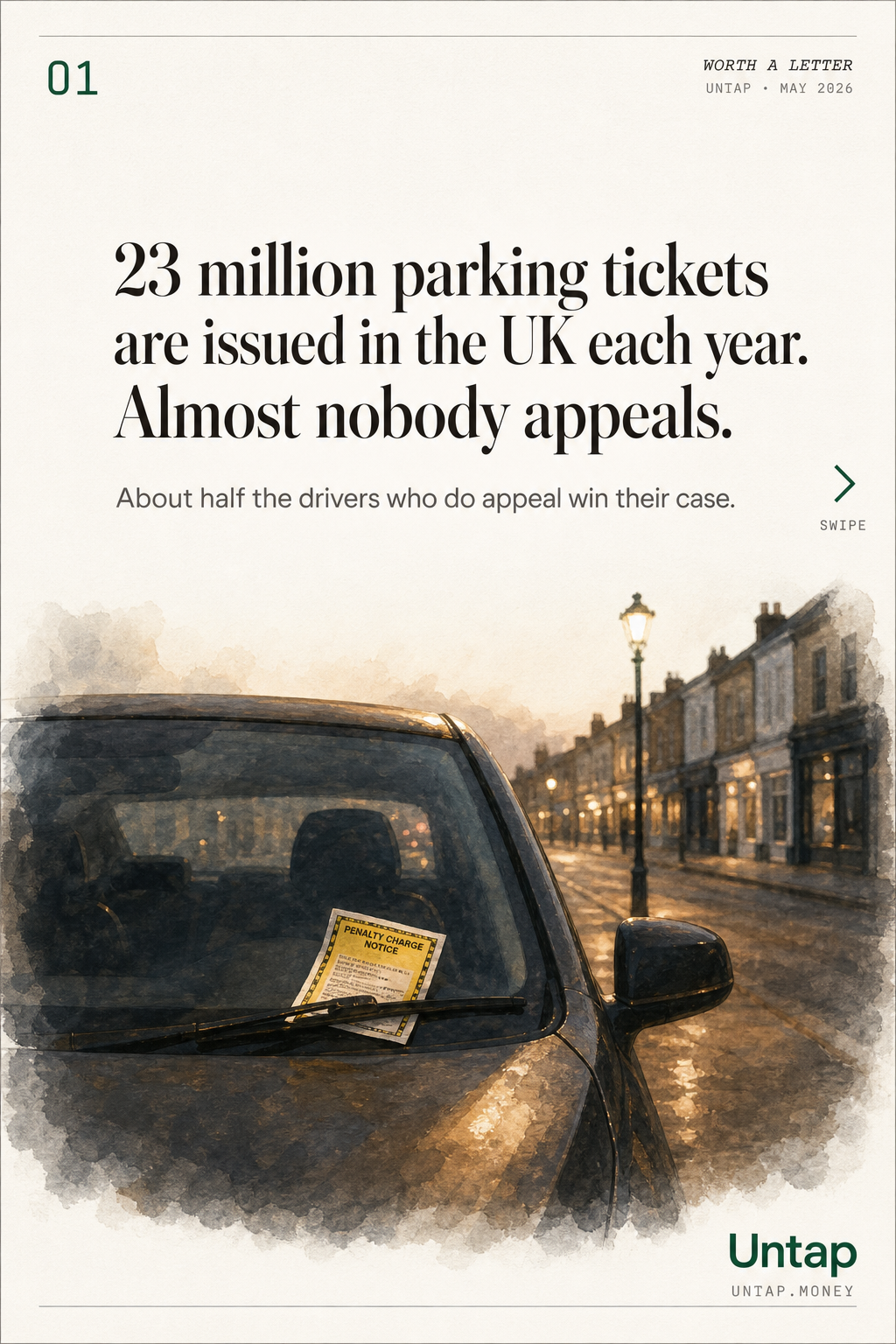
23 million tickets a year, and roughly £400 million quietly paid that didn’t need to be
Two streams flow into UK parking enforcement. The first is councils, which issued around 8.6 million Penalty Charge Notices in 2023-24 across England, Wales and Scotland for on-street, controlled-zone and council car-park contraventions (Source: RAC Foundation, Local Authority Parking Finances in England 2023-24, October 2024.). English councils alone generated a record £962 million surplus from on- and off-street parking operations that year, up 16 per cent on the previous year.
The second stream is private operators on retail parks, hospitals, supermarkets and apartment-block forecourts. They don’t publish their own ticket totals, but they pay the DVLA for vehicle-keeper data every time they post a notice to a registered keeper. In 2024-25 the DVLA processed 14.4 million such lookups, a record, more than double the 6.9 million recorded in 2018-19 (Source: DVLA, Release of Information from DVLA’s Registers Statistics, 2024-25.). That is the closest published proxy for private ticket volume.
Combine the two and a UK driver receives a parking ticket roughly every two seconds during business hours. About half a per cent of those tickets reach an independent appeals body. Of the ones that do, around half are upheld in the driver’s favour. Apply that selection effect across the issued pile, with realistic discounting for the cases that genuinely wouldn’t survive scrutiny, and a defensible mid-point lands at roughly £200 to £400 million in overpayment per year. The methodology is in the bridge below.
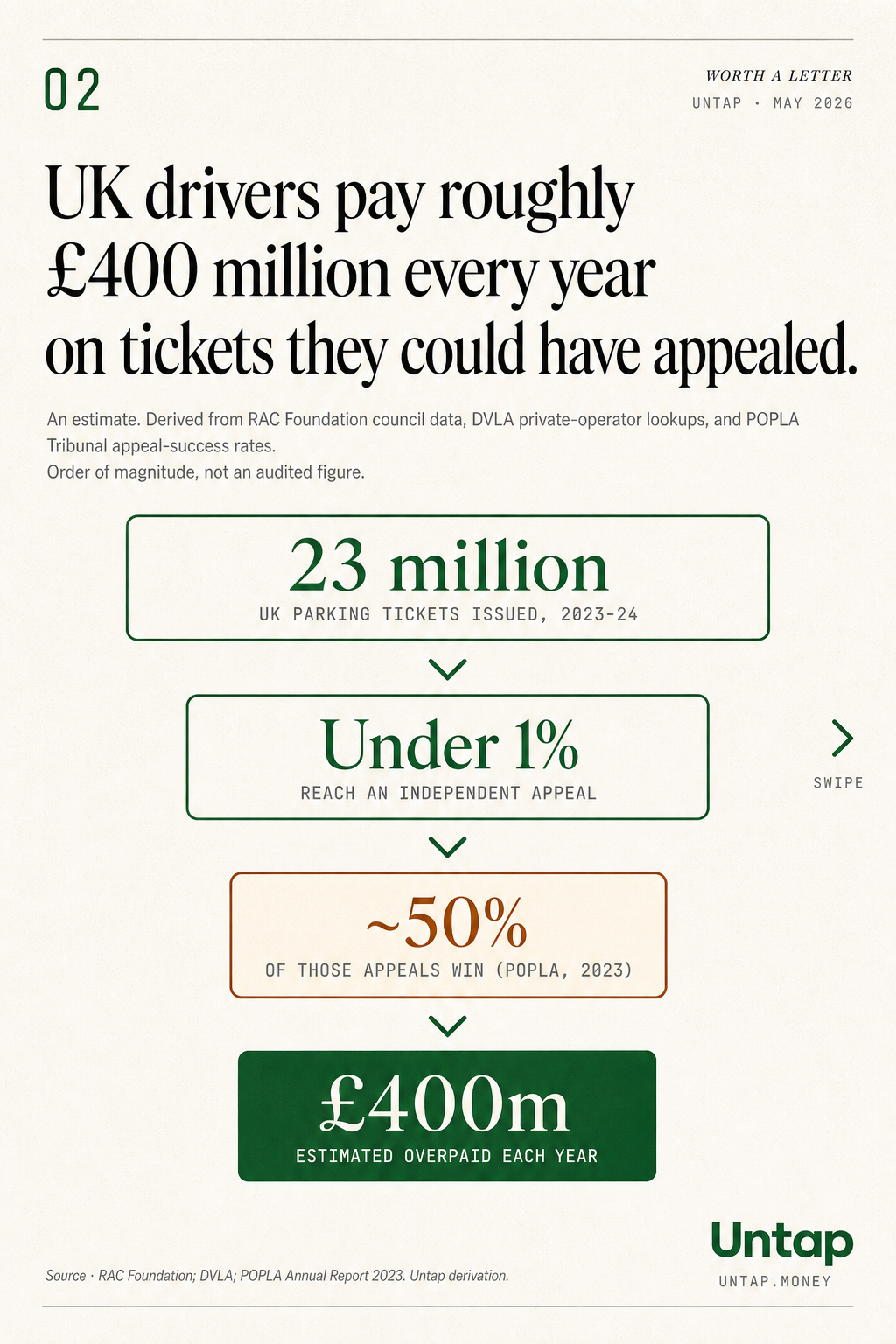
Three standard tiers, set by three different sources
The number on the notice depends on who issued it.
- Council PCN, outside London: £70 for the higher band, £50 for the lower band; halved if you pay within 14 days. Set by the Civil Enforcement of Parking Contraventions (England) General Regulations 2007 and unchanged since 2008 (Source: Civil Enforcement of Parking Contraventions (England) General Regulations 2007, SI 2007/3483.).
- Council PCN, inside London: £160 higher, £110 lower, halved within 14 days. Increased from £130 in July 2022 by the London Councils review, the first since 2011 (Source: London Councils, July 2022 fares update.).
- Private operator: £100 typical, £60 with the 14-day discount. Capped under the British Parking Association Code of Practice on most car parks. The International Parking Community sets a similar cap on its members’ sites.
The discount disappears the moment you appeal and lose. For a council PCN that means a £35 ticket can become a £70 one if the appeal goes the wrong way. The maths of when to risk the discount are why people pay on receipt; the maths of the actual win-rate at independent stage are why they probably shouldn’t.
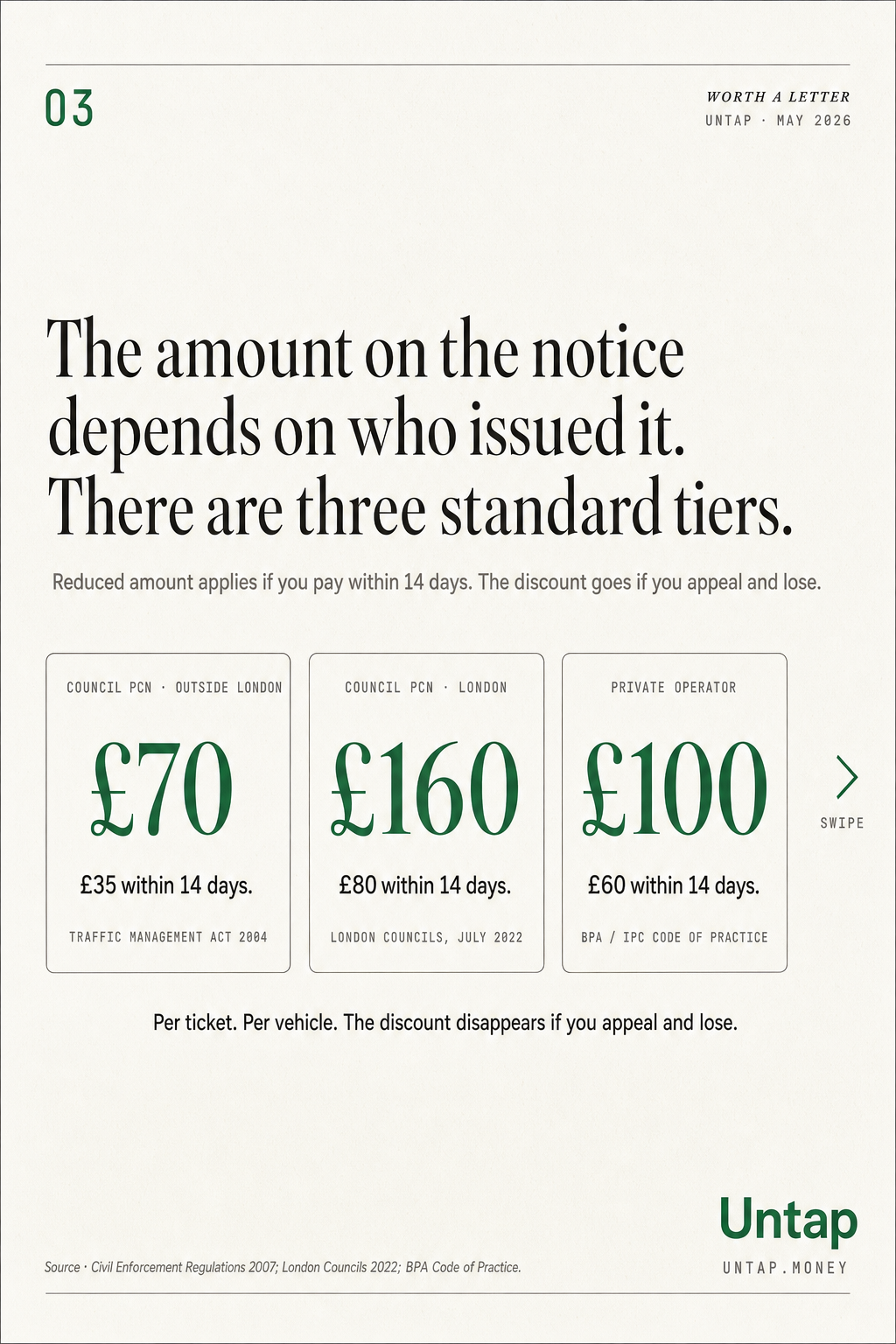
Half the appeals win. Under one in a hundred are ever sent
Three independent appeals bodies decide UK parking disputes, and they all publish their numbers.
POPLA, the appeals service for the British Parking Association, decided around 38,000 cases in 2023. (Source: POPLA Annual Report 2023.) 49 per cent were decided in the motorist’s favour: 35 per cent because the assessor agreed with the motorist on the merits, plus a further 14 per cent where the operator declined to defend. The maths is the same either way. Roughly half of the drivers who go through the trouble of appealing a private ticket get it cancelled.
The Traffic Penalty Tribunal, which handles council PCN appeals for England outside London and Wales, reported 57 per cent of contested appeals decided wholly or partly in the appellant’s favour in 2023-24 (Source: Traffic Penalty Tribunal Annual Report 2023-24.). That figure rises further once you include the cases where the council fails to file evidence at all, in which case the appellant wins by default.
London Tribunals, the equivalent body for the 33 London boroughs and TfL, allowed roughly 60 per cent of the appeals it decided in 2023-24 (Source: London Tribunals statistics, 2023-24.). Around 30 per cent of council respondents simply did not contest at all, the highest non-contested rate of the three bodies.
And the Independent Appeals Service, which handles cases for International Parking Community member operators, has long had the lowest motorist-success rate of the four, in the 22 to 25 per cent range. It has been criticised by Which? and is the appeals route most often cited as a problem when the proposed Government Code is discussed.
At every tier the published numbers tell the same story: the motorist who actually files an appeal wins more often than not, and far more often than the popular sense of "it’s a fine, you owe it" suggests. And yet the share of issued tickets that ever reach an independent stage is a fraction of one per cent. The other 99 per cent get paid.
The grounds that actually win
The single most common winning ground at POPLA is a Notice to Keeper served outside the strict 28-to-56 day window set by the Protection of Freedoms Act 2012. Get the date wrong, miss the prescribed wording, or fail to include the statutory photographs and keeper liability fails. Inadequate signage and ANPR misreads are the next two most common winners.
Protection of Freedoms Act 2012, Schedule 4
The Code that hasn’t arrived
The 2019 Act was meant to bring private parking under one statutory code with a £50 cap and a ban on the £70 "debt-recovery" surcharges operators add on top. The Code was published in February 2022, withdrawn four months later after a legal challenge from the trade bodies, and has been re-consulted on since. As of mid-2026 it is not yet in force.
Parking (Code of Practice) Act 2019; DLUHC Code, withdrawn June 2022
Check it yourself, or let Untap do it
The check is a short list. Confirm who issued the notice. Confirm the date the contravention happened and the date the notice arrived. Look at the signage at the location. Look at the photographs the operator included. Decide which of the common winning grounds applies. Write the appeal letter. None of that is hard. It is just tedious enough that most people don’t.
One thing on that list is worth doing before any of the others, because it changes how much the rest matters: find out who issued the notice. Operators differ enormously in whether they will actually defend a case. Some contest almost everything. Others drop four in five rather than turn up.
The full how-to, with the appeal letter template, lives in our guide: UK parking fines, explained.
Reproduce every figure in this piece
- RAC Foundation, Local Authority Parking Finances in England 2023-24 · The 8.6 million PCN figure and the £962 million surplus figure for 2023-24. Open
- DVLA Release of Information from DVLA’s Registers · 14.4 million keeper-data lookups by parking operators in 2024-25, up from 6.9 million in 2018-19. Open
- POPLA Annual Report 2023 · 49 per cent of appeals decided in the motorist’s favour. Read
- Traffic Penalty Tribunal Annual Report 2023-24 · Council PCN appeals (England outside London + Wales). 57 per cent of contested cases decided for the appellant. Read
- London Tribunals statistics 2023-24 · Council PCN appeals for the 33 London boroughs and TfL. About 60 per cent allowed in favour of the motorist. Read
- ParkingEye Ltd v Beavis [2015] UKSC 67 · UK Supreme Court, 4 November 2015. The benchmark case on the enforceability of private parking charges. Judgment
- Protection of Freedoms Act 2012, Schedule 4 · Keeper liability and the strict Notice-to-Keeper window for private operators. Read
- Civil Enforcement of Parking Contraventions (England) General Regulations 2007 (SI 2007/3483) · The £70 / £35 and £50 / £25 council PCN bands outside London. Unchanged since 2008. Read
- Parking (Code of Practice) Act 2019 · The enabling Act for a single statutory code. The 2022 Code was withdrawn after legal challenge and has been re-consulted on since. Read
See if yours is worth challenging
Thirty-one operators, with what actually happened to appeals against each. Free, and we take no percentage.
Worth a Letter is part of Untap’s research journal. The £200-400 million annual figure is a derived estimate from published RAC Foundation, DVLA and POPLA / Tribunal data, and is labelled as such throughout. Comments and corrections to contact@untap.money.
Published 2 May 2026.
4 in 5how often the most yielding operators fold
See your operator’s odds