Untap · Journal · 1 May 2026
Three Hours, Six Years
What UK air passengers are owed when a flight runs late, and the ruling that quietly closed the airlines’ favourite excuse
Around £1.7 billion in flight compensation goes unclaimed in the UK each year
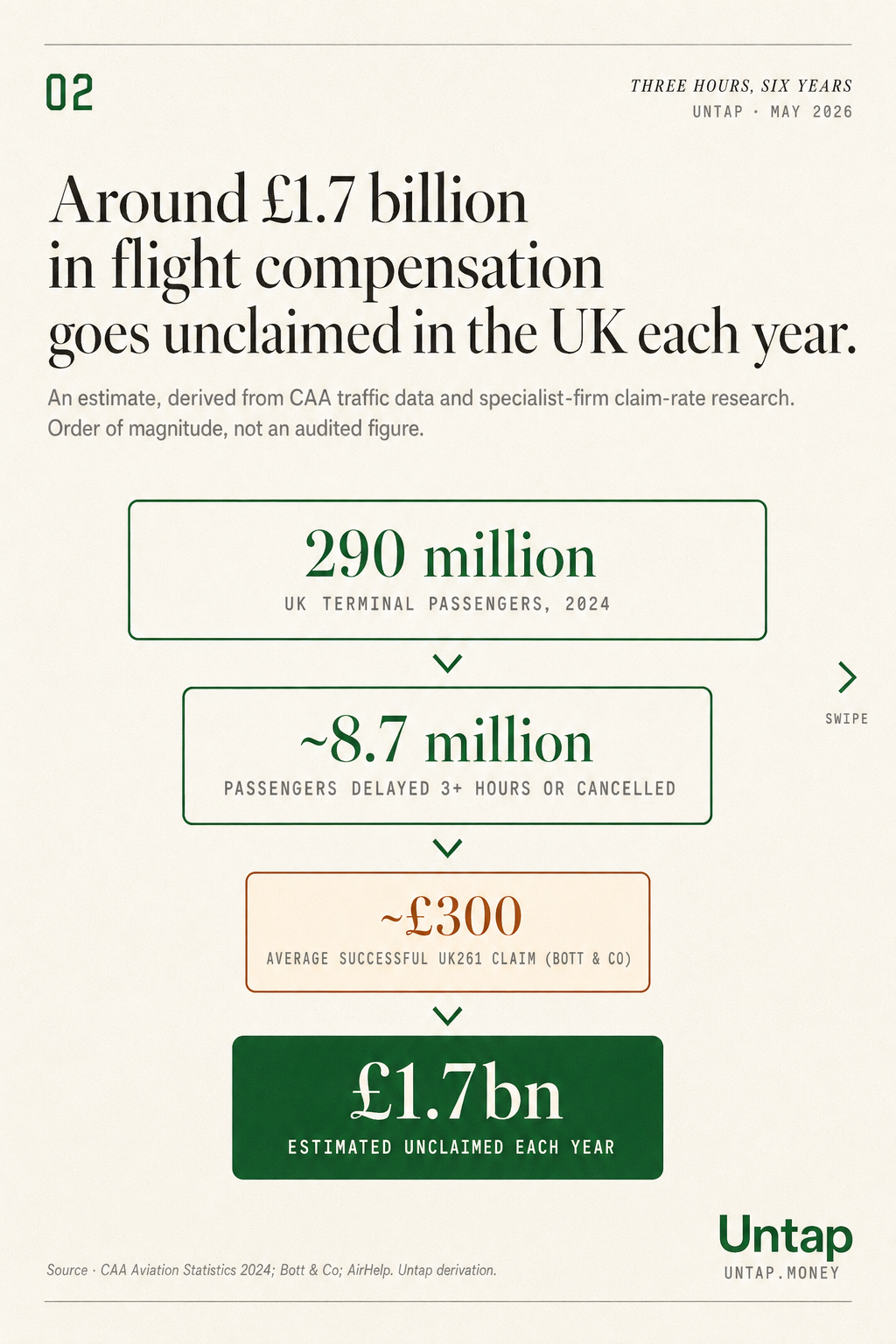
UK airports handled roughly 290 million terminal passengers in 2024, the highest annual total on record (Source: CAA UK airport statistics, annual data 2024.). In a typical year about 3% of departures arrive at least three hours late or are cancelled outright, the threshold at which UK261 compensation kicks in (Source: CAA UK Airline Punctuality Statistics, 2024.). That is on the order of 8 to 9 million passenger journeys per year sitting inside the eligibility window.
The legal firm Bott & Co, which has handled UK261 claims since the EU rule came into force in 2005, reports the average successful claim is around £300 per passenger (Source: Bott & Co, Flight Delay Pay Check reports.). The CAA Aviation Consumer Survey has long found that only about one in three eligible passengers actually claims (Source: CAA Aviation Consumer Survey, awareness chapter.). Combine the three numbers and you arrive at a rough order of magnitude: roughly £1.7 billion in UK261 compensation owed to UK passengers each year, and not asked for.
That is an estimate, not an audited figure. The airlines do not publish UK261 payouts as a separate line. Bott & Co and AirHelp publish their own headline numbers, and they each land within the same order of magnitude. The point is the scale: the unclaimed pile dwarfs the £80 million we estimate for unclaimed rail Delay Repay (Source: ORR rail compensation statistics, 2024.) and the £164.7 million TfL collected from incomplete contactless journeys in 2023 (Source: TfL FOI-4311-2324, 25 March 2024.).
The compensation is fixed, in pounds, and per passenger
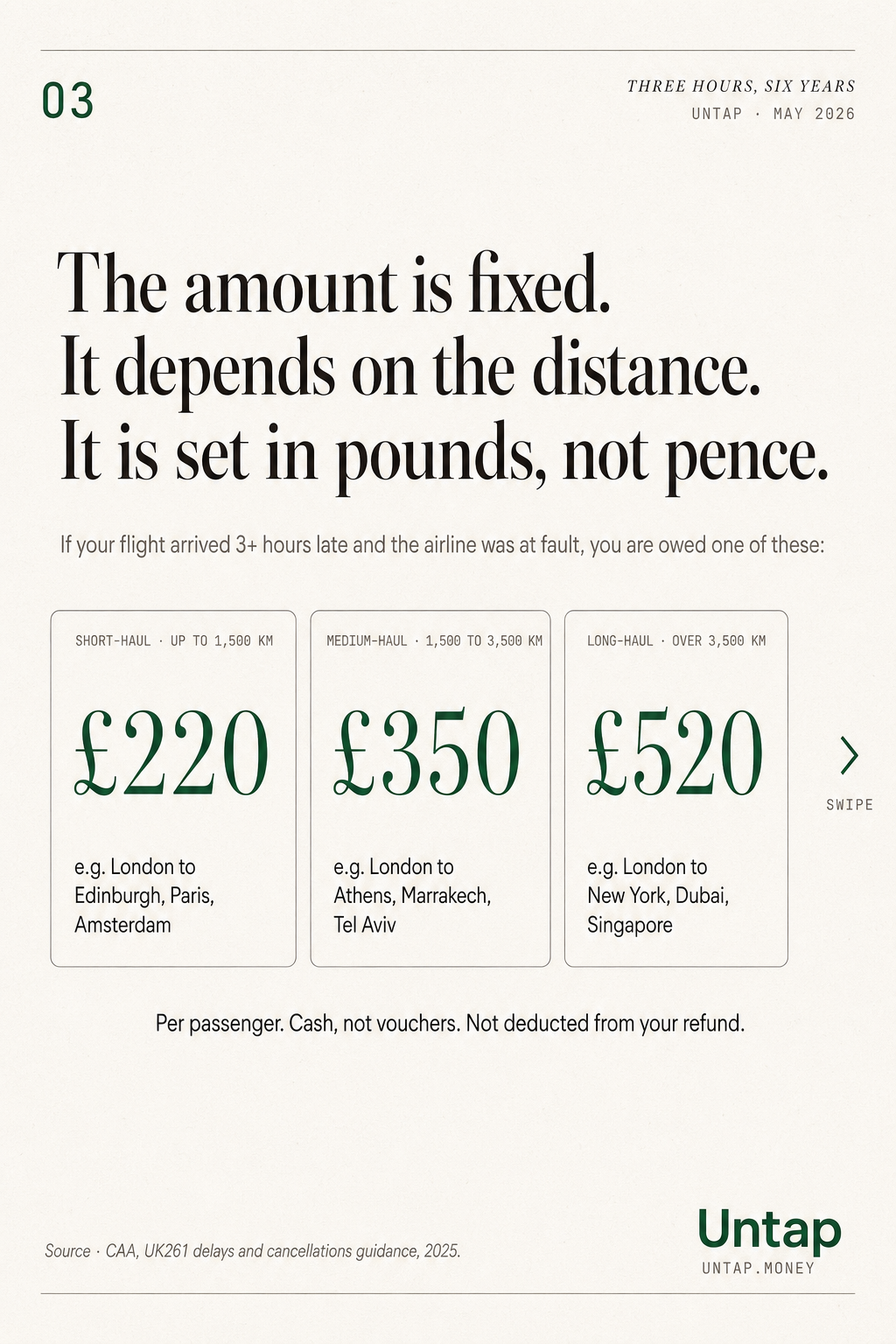
UK261 is the post-Brexit version of EU Regulation 261/2004, retained in UK law in 2019. The compensation tiers are unchanged and denominated in pounds for UK departures (Source: Air Passenger Rights and Air Travel Organisers’ Licensing (Amendment) (EU Exit) Regulations 2019.):
- £220 for short-haul flights up to 1,500 km (e.g. London to Edinburgh, Paris, Amsterdam).
- £350 for medium-haul, 1,500 to 3,500 km (e.g. London to Athens, Marrakech, Tel Aviv).
- £520 for long-haul, over 3,500 km (e.g. London to New York, Dubai, Singapore). Halved to £260 if the delay is between three and four hours.
The amount is paid per passenger, in cash. It is not a voucher, it is not deducted from any refund you separately receive for the flight, and a family of four on a delayed long-haul return is entitled to £2,080 in their own right. Children pay the adult tier; there is no discount on the compensation (Source: CAA UK261 delays and cancellations guidance, 2025.).
Two qualifying conditions matter. The flight must arrive at destination at least three hours late, measured by door-open time, not push-back. And the delay or cancellation must be within the airline’s control. Severe weather, unforeseen air-traffic-control disruption and properly substantiated security incidents are extraordinary; crew rostering, technical faults on the aircraft, and now staff illness are not. More on that below.
The Supreme Court closed the “sick pilot” loophole
For a decade after EU261 took effect, airlines defended a growing number of refusals by stretching the “extraordinary circumstances” exemption. The first major narrowing came in Huzar v Jet2.com in 2014, where the Court of Appeal held that a routine technical fault on an aircraft is not extraordinary; it is part of running an airline (Source: Huzar v Jet2.com [2014] EWCA Civ 791.). Most mechanical refusals have collapsed since.
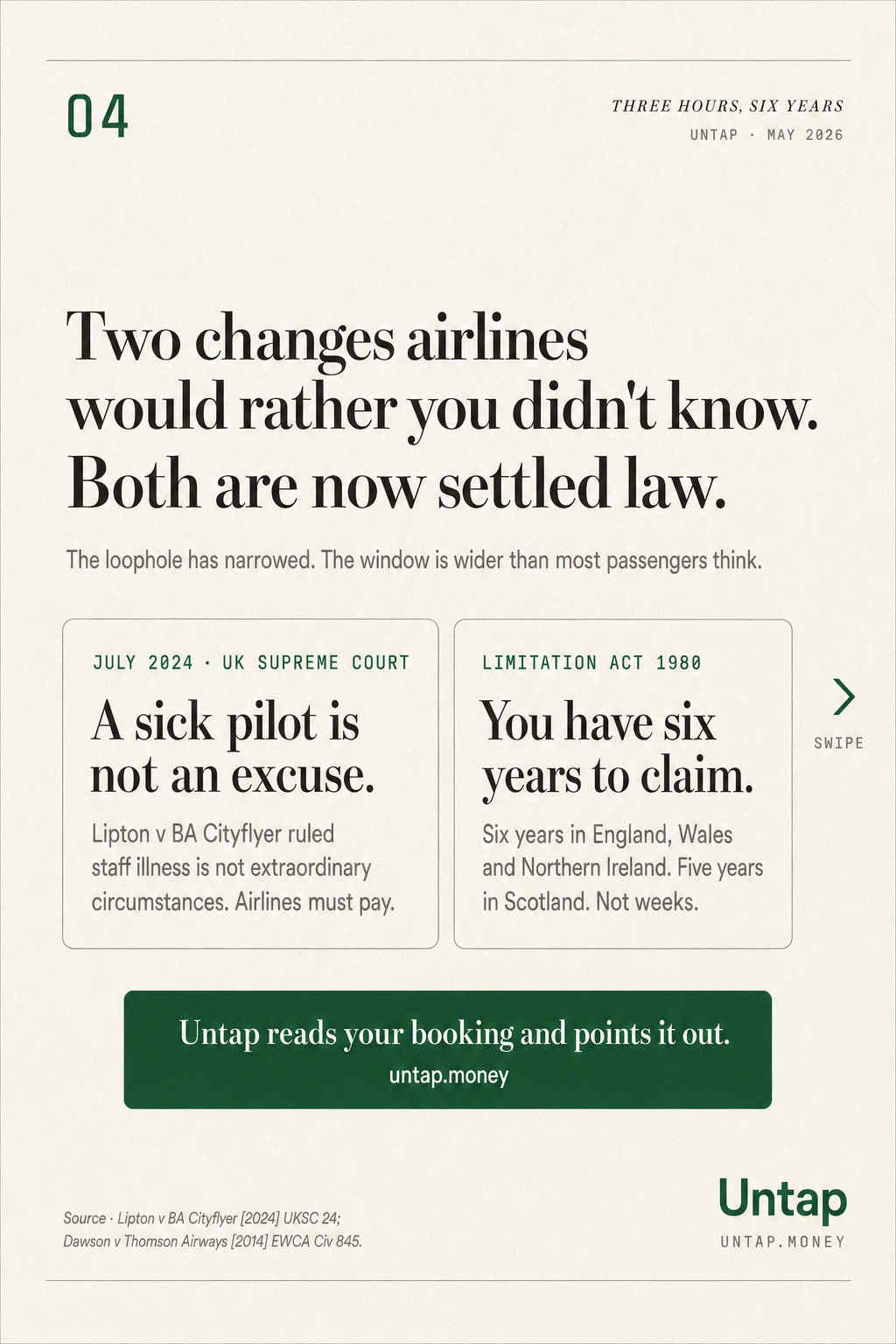
The next decade was spent on staff. British Airways, in particular, argued in Lipton v BA Cityflyer that a captain calling in sick the morning of a flight was outside the airline’s control and therefore extraordinary. The argument was rejected at every stage, and on 10 July 2024 the UK Supreme Court delivered the final word: staff illness is inherent to operating an airline, and an airline cannot avoid UK261 compensation by treating its own crew rostering as an external event (Source: Lipton v BA Cityflyer Ltd [2024] UKSC 24, judgment of 10 July 2024.).
That single ruling closes the most-used denial reason of the past five years. Bott & Co and AirHelp both flagged it as the most consequential UK261 decision since Huzar. If you have had a UK261 claim refused since 2018 on grounds of crew illness, the refusal is very likely no longer defensible, and the claim may still be in time.
You have six years to claim, not weeks
UK261 does not set its own time limit, so the general limitation rules apply. In England, Wales and Northern Ireland the window is six years, under section 5 of the Limitation Act 1980; in Scotland it is five, under the Prescription and Limitation (Scotland) Act 1973. The Court of Appeal confirmed in Dawson v Thomson Airways in 2014 that the standard six-year contract limitation period applies to flight compensation claims (Source: Dawson v Thomson Airways [2014] EWCA Civ 845.).
That means a London passenger on a flight delayed in summer 2020 can still bring a UK261 claim today. Most airlines do not advertise this. Their booking apps tend to surface a “contact us within 14 days” note that has nothing to do with the legal window; it is a customer-service preference, not the rule.
The Civil Aviation Authority has long pushed for stronger direct enforcement powers. As of 2024 the regulator could only pursue airlines through the courts, a slow route that has limited the number of formal monetary fines. In early 2024 the CAA opened formal enforcement against Wizz Air UK over poor handling of cancellations and EU261 claims, with Wizz signing undertakings to pay outstanding claims (Source: CAA enforcement notice, Wizz Air UK, February 2024.). For most passengers the practical route is still the airline’s own portal.
One incident, one day
A single malformed flight plan caused the UK’s air-traffic control system to fall back to manual mode for most of a bank-holiday Monday. Around 1,500 flights were cancelled on the day, with disruption rolling on for days. The CAA confirmed the failure was not extraordinary circumstances for airlines; passengers were entitled to UK261 in addition to rebooking and care.
NATS CP1 Major Incident Report, March 2024
The 14-day cancellation rule
If an airline cancels with less than 14 days’ notice and cannot offer a tightly equivalent rerouting, compensation is owed in addition to the refund. There is no public dataset on the share of cancellations falling inside the 14-day window. We have a Freedom of Information request open with the CAA for it.
UK261 Article 5
Check it yourself, or let Untap do it
The check is mechanical. Pull up the flight, confirm scheduled and actual arrival times, look up the great-circle distance, decide which tier applies, and check whether the airline’s stated cause of delay falls inside or outside the extraordinary-circumstances list. None of that is hard; it is just tedious to do for every flight in your booking history.
Untap reads your booking confirmation and does the check against current flight-status data. We tell you what the tier is, whether the cause of delay disqualifies the claim, and how to file with the airline. Forward your confirmation to the address inside your Untap inbox and we will flag every claimable journey. We do not file the claim. That part stays with you, on the airline’s portal.
The full how-to, with screenshots and the edge cases, lives in our guide: Flight compensation, explained.
Reproduce every figure in this piece
- CAA UK261 delays and cancellations guidance · The compensation tiers, the qualifying conditions, the role of extraordinary circumstances. Read
- CAA UK Airline Punctuality and Aviation Statistics · Annual passenger volumes, on-time performance, cancellation and 3+ hour delay rates by airport and airline. Open
- Lipton v BA Cityflyer Ltd [2024] UKSC 24 · UK Supreme Court, 10 July 2024. Staff illness is not extraordinary circumstances under UK261. Judgment
- Dawson v Thomson Airways [2014] EWCA Civ 845 · Court of Appeal confirms a six-year limitation period applies to EU/UK261 claims. Read
- Huzar v Jet2.com [2014] EWCA Civ 791 · Routine technical faults are not extraordinary circumstances. Read
- NATS CP1 Major Incident Report · The 28 August 2023 air-traffic-control failure: 700,000 passengers affected, 1,500 flights cancelled on the day, disruption rolling on for days. Read
- CAA enforcement notice, Wizz Air UK, February 2024 · Wizz Air UK formally enforced against over poor handling of cancellations and EU261 claims. Open
- Bott & Co Flight Delay Pay Check · Average successful UK261 claim around £300; cumulative estimate of £5.2 billion unclaimed since 2005. Open
Find your flight in the table
Free, and we take no percentage. We do not file the claim: you send it to the airline yourself, and every pound stays yours.
Three Hours, Six Years is part of Untap’s research journal. Headline numbers are triangulated from the CAA, the courts, and specialist legal firms; the £1.7 billion annual figure is a derived estimate and labelled as such throughout. Comments and corrections to contact@untap.money.
Published 1 May 2026.
£220 to £520what one badly delayed flight can owe you
Find your flight in the table