Untap · Money Owed · 14 May 2026
Money Owed · Renters
What changed for English renters on 1 May, and the money your landlord already owes you under the older rules

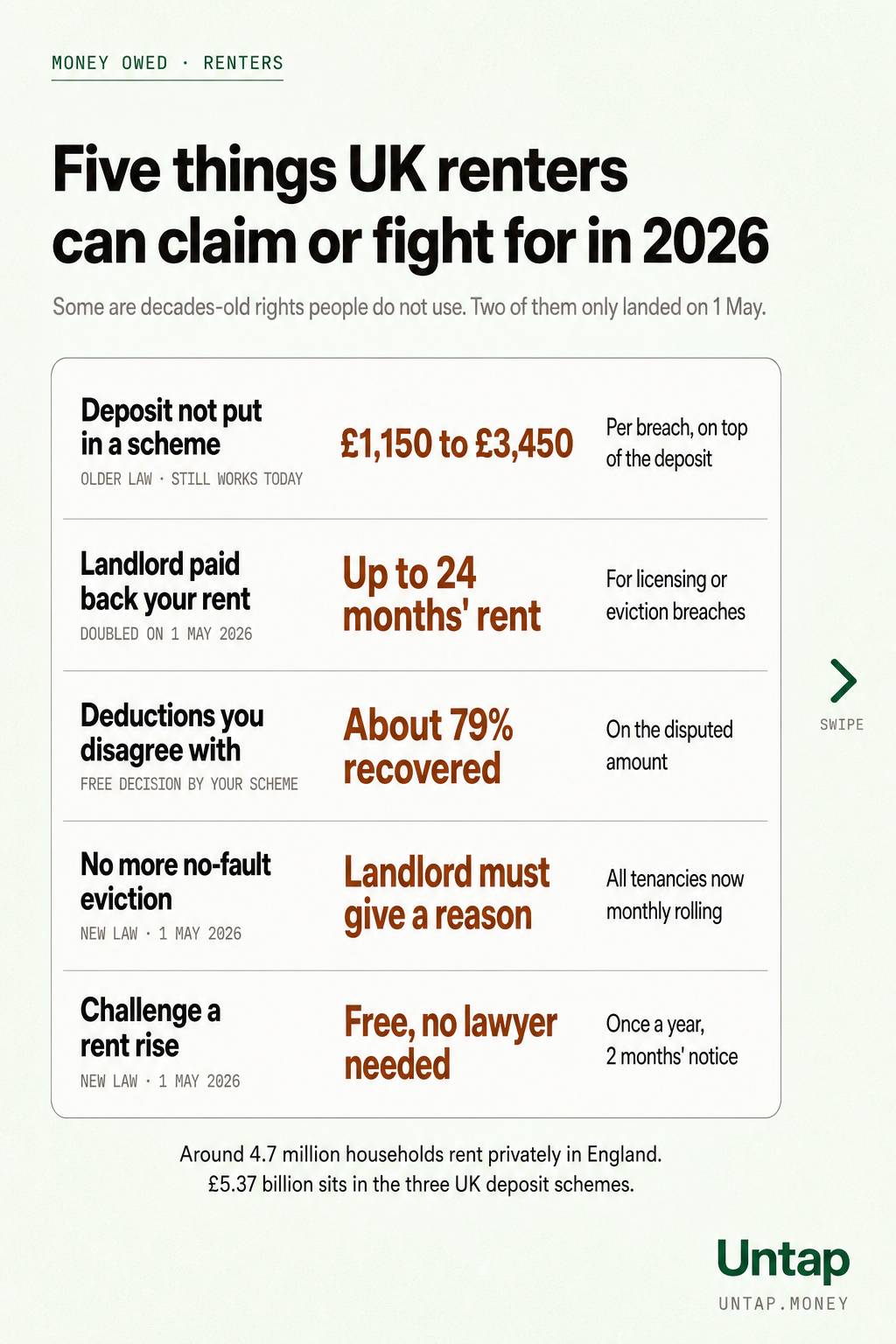
Most of the Renters’ Rights Act 2025 is now in force
The Renters’ Rights Act 2025 received Royal Assent on 27 October 2025 (Source: Renters’ Rights Act 2025 (c. 26), legislation.gov.uk.). Most of the Act’s consumer-facing provisions for the private rented sector in England commenced on 1 May 2026, via a Statutory Instrument that bundled them into a single switch-on date (Source: The Renters’ Rights Act 2025 commencement regulations (the 1 May 2026 commencement order); MHCLG implementation guidance, November 2025.).
The provisions now in force include:
- No-fault evictions abolished. A landlord can no longer use the old section 21 procedure to end a tenancy without a reason. Possession now requires a prescribed ground.
- Fixed-term contracts abolished. Every assured tenancy in England, new and existing, is now an assured periodic tenancy rolling monthly. Tenants can end the tenancy on two months’ notice; landlords need a prescribed ground.
- Rental bidding wars banned. The landlord or agent must publish an asking rent and cannot accept offers above it.
- Rent in advance limited to one month. A landlord cannot demand more than one month’s rent up front before a tenancy is signed.
- Rent rises capped to one a year, with formal notice. The landlord must serve a Form 4A (the replacement section 13 notice under the new Act) giving at least two months’ notice. The tenant can refer the proposed rent to the First-tier Tribunal (Property Chamber) for free; the tribunal can confirm the rent or reduce it, but cannot raise it above the landlord’s proposal.
- Rent Repayment Orders doubled. The maximum award has doubled from 12 to 24 months’ rent, and the grounds have been extended. These orders cover landlord offences such as renting without a required licence, illegal eviction or harassment.
- Pet requests must be considered. The landlord has 28 days to reply in writing and can only refuse with a reasonable reason.
- Discrimination against tenants with children or on benefits is now unlawful.
A few headline reforms are not yet in force on 14 May 2026. The Private Rented Sector Database is rolling out later in 2026 to 2027. The Private Rented Sector Ombudsman is expected in 2028. The Decent Homes Standard for private rentals, and the extension of Awaab’s Law to private tenancies, both remain in Phase 3 of the implementation roadmap, subject to consultation (Source: Renters’ Rights Act 2025 implementation roadmap, MHCLG, November 2025.). Do not assume those rules apply yet.
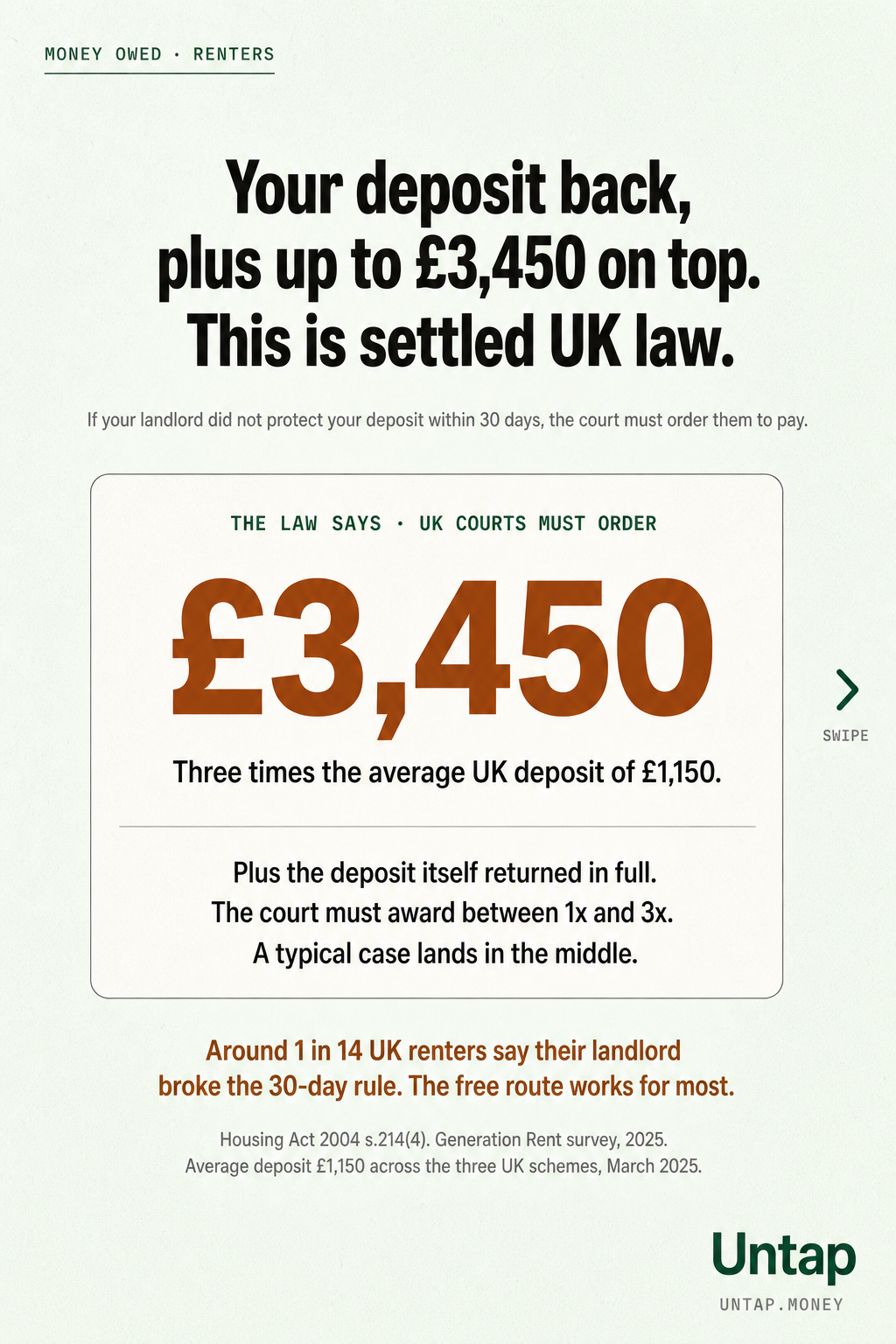
One to three times your deposit, on top, if the landlord broke the 30-day rule
This is not new. It has been the law since the Housing Act 2004 was strengthened by the Localism Act 2011. Almost twenty years on, it is still the single largest direct cash recovery a private renter has under English law and most renters do not know about it.
When a landlord receives a tenancy deposit, they have 30 days to do two things. First, protect the deposit in one of the three government-approved schemes: the Deposit Protection Service, the Tenancy Deposit Scheme, or MyDeposits. Second, give the tenant the prescribed information (scheme name, deposit amount, what counts as a permitted deduction, how disputes are handled) (Source: Housing Act 2004 ss.213-215; Housing (Tenancy Deposits) (Prescribed Information) Order 2007, SI 2007/797.).
If they fail at either step, the consequence is fixed. A county court must order the landlord to pay the tenant a sum between one and three times the deposit, on top of returning the deposit itself (Source: Housing Act 2004 s.214(4) as amended by Localism Act 2011 s.184.). The Court of Appeal in Tiensia v Vision Enterprises had earlier let landlords avoid the penalty by protecting late; section 184 of the Localism Act 2011 reversed that. Late protection no longer cures the breach.
The average UK tenancy deposit, across all three schemes on 31 March 2025, was £1,150 (Source: DPS, TDS and MyDeposits annual reports, aggregated by Generation Rent in Short-changed, July 2025.). Three times that is £3,450, plus the deposit returned, for a total of £4,600. The court chooses where to land within the one-to-three multiplier based on the seriousness of the breach. The multiplier applies to whatever your deposit actually was: if you paid £2,000, three times is £6,000.
Two practical caveats. The six-year window runs from when the 30-day deadline was missed, not from when you moved out, so a tenancy that started in 2019 may already be time-barred. And most claims are against a former landlord. If you are still renting from them, or might need a reference, weigh the relationship cost before filing.
How common is this? A nationally representative survey of 2,000 private renters in July 2025 found that about 7% of renters say their deposit was never properly protected (Source: Generation Rent, Short-changed: making deposit protection work for renters, July 2025 (Opinium fieldwork).). On a private rented sector of 4.7 million households in England alone (Source: English Housing Survey 2024-25 headline report, MHCLG.), that is hundreds of thousands of tenancies where the penalty would be claimable.
The scheme adjudication is free, fast, and weighted toward the renter when there is evidence
The other deposit problem is more familiar: the tenancy ends, the landlord proposes deductions for cleaning, paint, wear, broken keys, and so on, and the tenant disagrees. In this scenario the deposit is properly protected, so the 1 to 3 times penalty is not in play. What is in play is the free adjudication service that each of the three schemes runs.
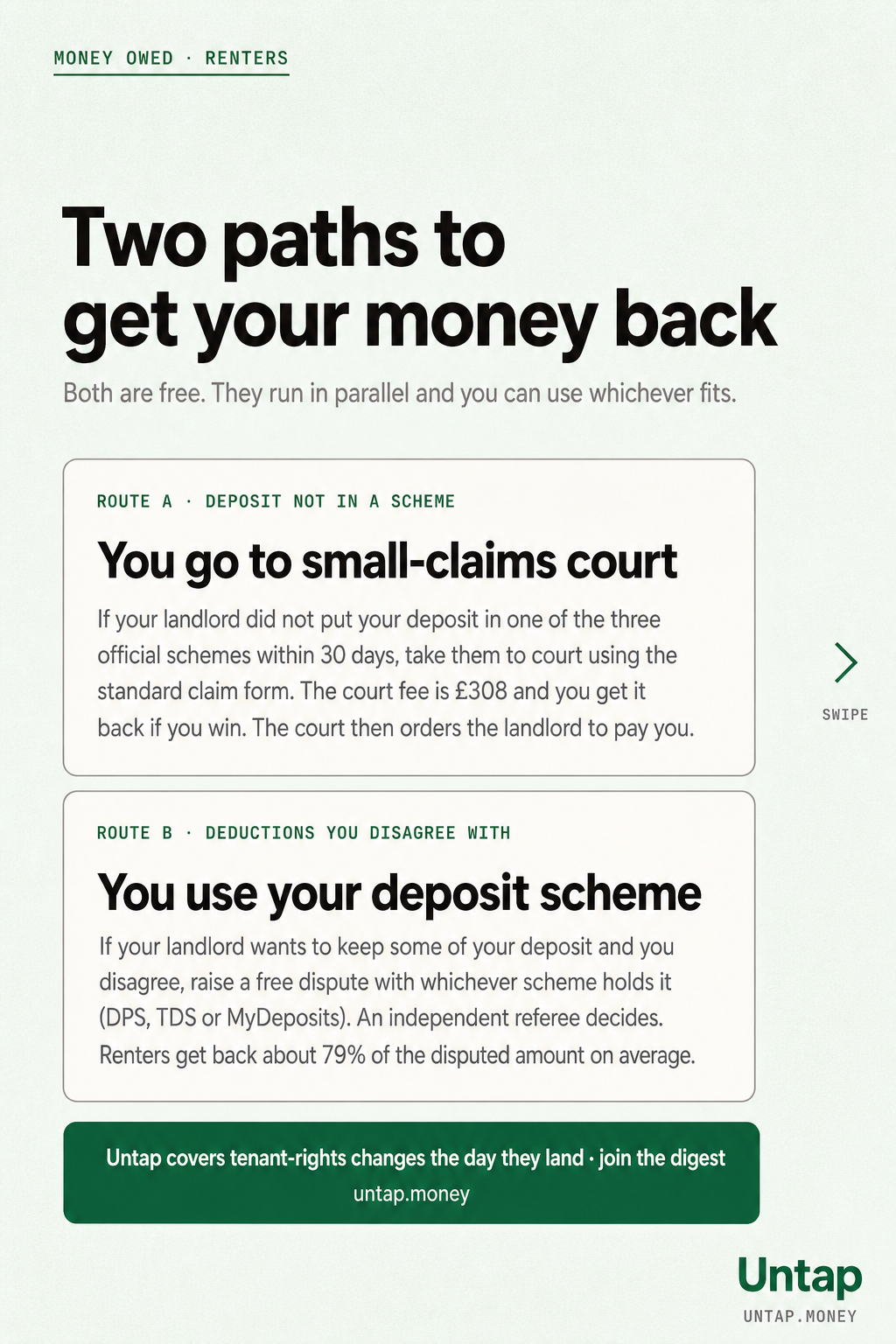
In the year to March 2025 the schemes adjudicated about 46,950 disputes (Source: Tenancy Deposit Scheme statistical briefing 2024-25, summarised by the National Residential Landlords Association.), roughly 1% of all tenancies ending in that window. When tenants do file a formal dispute, the scheme’s own published outcome data shows the renter recovers, on average, around 79% of the disputed amount, and around 32% recover the full sum (Source: Generation Rent, Short-changed, July 2025 (citing scheme adjudication outcomes; Opinium fieldwork, n=2,000).).
The mechanism rewards documentation: photos, the inventory, dated receipts, copies of the prescribed information. The schemes resolve in roughly four to six weeks on average. The decision is binding if both parties opted in. There is no fee.
The awareness gap is the bigger problem. The same survey found that 46% of renters did not know they could challenge deductions through the scheme at all. Of the 22% who reported losing money to unfair deductions, only a fraction had formally disputed.
The five-week deposit cap is still the law
A landlord cannot demand more than five weeks’ rent as a tenancy deposit (six weeks if the annual rent is at least £50,000). The holding deposit before signing is capped at one week’s rent. Anything over those limits is recoverable through the First-tier Tribunal (Property Chamber). Civil penalties for the landlord run up to £5,000 for a first breach and £30,000 for a repeat.
Tenant Fees Act 2019, Schedule 1
Re-protection on tenancy roll-over
The Court of Appeal held in 2013 that when a fixed-term tenancy rolled into a statutory periodic tenancy, a new deposit was treated as received and had to be re-protected with fresh prescribed information. Many landlords missed this. The penalty is the same one to three times the deposit. After 1 May 2026 every assured tenancy is periodic by default, so the roll-over trigger largely disappears for new tenancies — but stays live for the legacy cohort whose tenancies rolled over before May 2026 and are still within the six-year claim window.
Superstrike Ltd v Rodrigues [2013] EWCA Civ 669
Five practical routes, all free, all under English law
- Deposit was never protected. Check the three schemes for any record of your deposit (each runs a tenancy-lookup page). If none has it, file form N208 at your local county court citing Housing Act 2004 sections 213 and 214. The court fee is £308 and is recoverable if you win.
- Deductions you disagree with. Raise a dispute through whichever scheme holds the deposit. The decision is independent, free, and usually decided in four to six weeks.
- Illegal fees on top of rent / deposit. Apply to the First-tier Tribunal (Property Chamber) for repayment, plus interest. Also report the landlord to your council’s Trading Standards team, which enforces civil penalties of up to £5,000 to £30,000.
- Landlord offence (no licence, illegal eviction, harassment). Apply to the First-tier Tribunal (Property Chamber) for a Rent Repayment Order. The maximum award doubled from 12 to 24 months’ rent on 1 May 2026.
- Rent rise you think is too high. Wait for the Form 4A (the new section 13 notice) your landlord must serve, then refer it to the First-tier Tribunal within the two-month window. The tribunal can confirm or reduce the rent, but not raise it above the landlord's proposal.
Untap covers tenant-rights changes as they land and the free routes you can use to act on them. Join the weekly digest at untap.money if you would rather not track the schedule yourself.
One last note on the firms that may approach you. The free routes above work for most claims and most renters can run them without a lawyer. Legitimate housing solicitors, law centres and Shelter advisers exist and may be the right answer if your circumstances are unusual (a complex disputed-facts case, non-English first language, a vulnerable tenant). Avoid no-win-no-fee firms that ask for a percentage of money you could recover yourself for the cost of a £308 court fee. No one needs to register you for any of these rights. If anyone phones or texts asking for a fee to do so, it is a scam.
Reproduce every figure in this piece
- Renters’ Rights Act 2025 (c. 26) · Royal Assent 27 October 2025. The reform package. Read
- SI 2026/421 · The commencement regulations bringing the headline provisions into force on 1 May 2026. Read
- Housing Act 2004, section 214 · The provision that requires the court to order between one and three times the deposit when protection or prescribed information was missed. Read
- Tenant Fees Act 2019 · The cap on holding deposits, tenancy deposits and the list of permitted fees. Read
- Superstrike Ltd v Rodrigues [2013] EWCA Civ 669 · Court of Appeal: re-protection required when a fixed term rolls into a periodic tenancy. Read
- Generation Rent, Short-changed (July 2025) · Opinium fieldwork (sample 2,000 nationally representative private renters). 7% deposit unprotected; 22% disputed deductions; 79% average recovery on disputed sums; £5.37 billion in the three schemes. Read
- English Housing Survey 2024-25 · 4.7 million private rented households in England, 19% of all households. Open
See if your deposit was protected
Free with a sign-in, and we take no percentage. If the dates do not support a claim, we tell you that too.
Money Owed · Renters is the fourth instalment of Untap’s Money Owed series. All headline figures are from primary sources: the Act and commencement SI on legislation.gov.uk, the Housing Act 2004 and Tenant Fees Act 2019, and the published deposit-scheme aggregates. Survey-derived figures (the 7%, 22%, 79% and £5.37bn lines) are from Generation Rent’s July 2025 Opinium fieldwork and are clearly attributed. Comments and corrections to contact@untap.money.
Published 14 May 2026.
1 to 3 timesyour deposit, if it was never protected