Untap · Money Owed · 9 May 2026
Money Owed · HMRC
Five reliefs UK adults qualify for and don’t claim. What each is worth, and how to fix it
Around £1.5 billion sits unclaimed at HMRC each year, most of it in pensions
HMRC publishes the cost of reliefs claimed every December. It does not publish the cost of reliefs left unclaimed. The gap is, by design, invisible to the regulator (Source: National Audit Office, The effective management of tax reliefs, August 2022.). Five reliefs make up most of that gap.
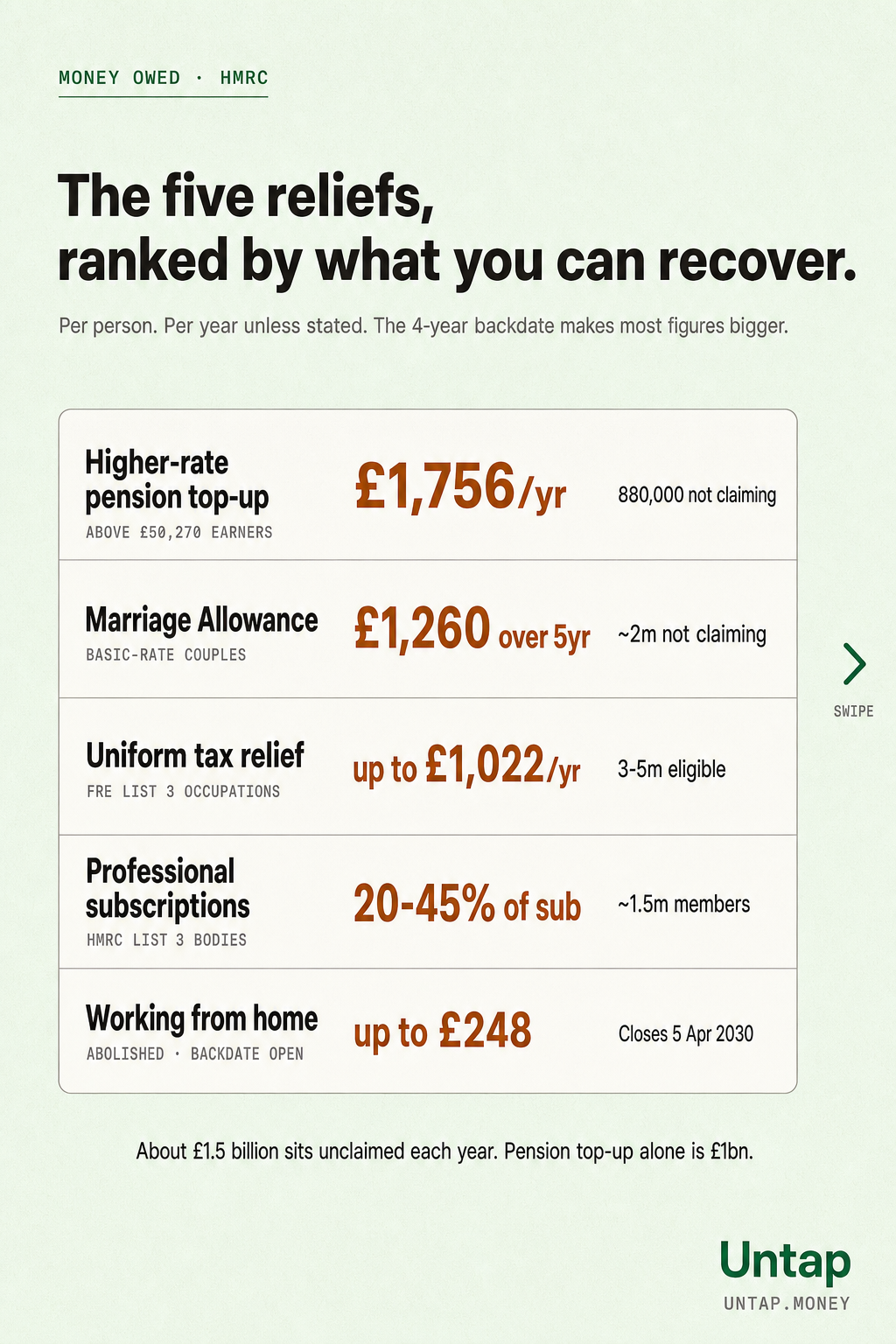
The single largest pile is higher-rate pension tax top-up. Most personal and workplace pension schemes use a mechanism called relief-at-source: the pension provider automatically applies 20% basic-rate tax relief and adds it to the pot. If you pay tax at the higher rate (40%) or the additional rate (45%), the extra 20% or 25% is owed to you, but you have to claim it yourself, through Self Assessment or a written claim to HMRC.
A 2024 Freedom of Information request by Steve Webb at LCP found that of around 1.2 million higher- and additional-rate taxpayers expected to be making relief-at-source pension contributions in 2023-24, only 316,000 declared the contributions on a tax return. That leaves roughly 880,000 higher-rate earners not claiming their top-up, with an average claim worth £1,756 a year (Source: Corporate Adviser, FOI by Steve Webb / LCP, covering 2023-24.). The aggregate is over £1 billion a year, before any backdating.
Marriage Allowance is the most-published example. 4.2 million UK couples are eligible. Only 2.35 million claim (Source: HMRC Non-structural tax relief statistics, December 2024; House of Commons Library Briefing SN00870, May 2025.). The remaining 1.85 million couples are missing £252 a year in basic-rate tax relief, with a four-year backdate available to anyone who has been eligible since 2022-23. A new claim today is worth up to £1,260 cash back. Take-up has been stuck at around 48% of eligible couples since the relief was launched in 2015.
Three smaller piles round out the £1.5 billion figure: uniform tax relief (most workers in the FRE list), professional subscriptions to bodies on HMRC List 3, and the closing-window WFH relief. Per person they are smaller, but combined they sit in the £100 million per year range.
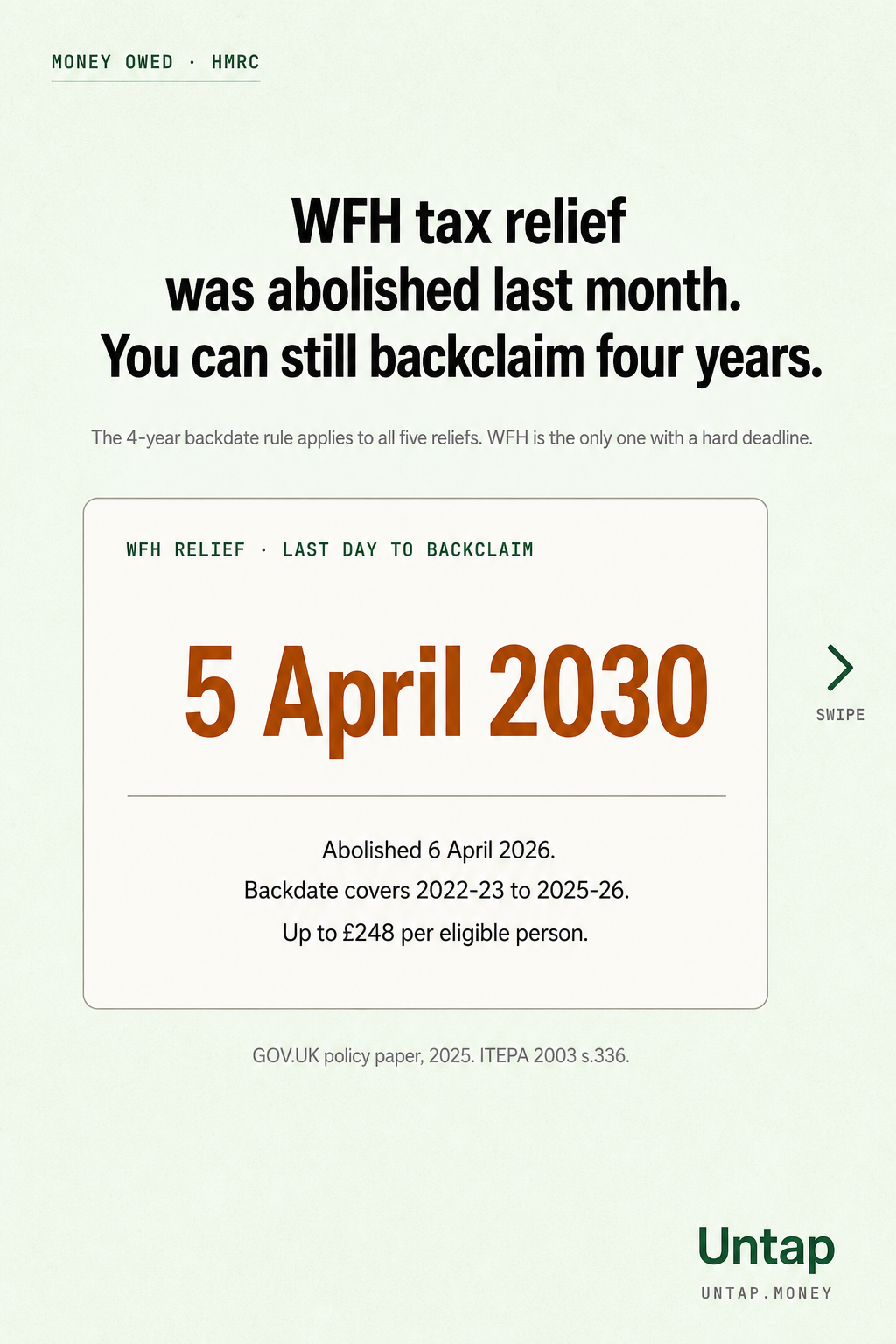
Working-from-home tax relief was abolished, the backdate is open until 5 April 2030
On 6 April 2026, last month, the tax relief for non-reimbursed homeworking expenses was abolished (Source: GOV.UK policy paper: Removal of tax relief on non-reimbursed homeworking expenses, 2025.). That removes the relief going forward. It does not remove the four-year backdate window for anyone who was required to work from home in any year since 2022-23.
The eligibility test is narrow. Voluntary hybrid working does not qualify. The employer must have required the work to be done from home, with no employer-provided alternative workplace. Anyone who fits that description for any of the tax years 2022-23, 2023-24, 2024-25 or 2025-26 has until 5 April 2030 to claim. The amount is small (£62.40 a year at basic rate, £124.80 at higher rate), so a maximum backclaim is £248 at basic rate or £499 at higher rate.
The harder question is whether you actually qualified. HMRC has stated that more than half of WFH claims it has checked under the post-2022 rules were ineligible (Source: GOV.UK policy paper, 2025.). That is partly why the relief is being removed.
Two reliefs aimed at specific occupations
Uniform tax relief, formally Flat Rate Expenses, applies to workers whose job requires a uniform or specialist clothing they have to maintain themselves. HMRC keeps a list of occupations and per-occupation flat rates (Source: HMRC Employment Income Manual EIM32712.). The default is £60 a year (basic-rate refund: £12). Nurses and midwives are listed at £125 a year. Police constables to chief inspectors at £140. Airline pilots at £1,022. Each year is its own relief, so the four-year backdate compounds: a nurse who has never claimed is owed £625, a pilot who has never claimed is owed up to £5,110.
Professional subscriptions tax relief lets members of professional bodies deduct their subscription costs from their taxable income, where the membership is required for the job (Source: HMRC Employment Income Manual EIM32880; Section 344 of the Income Tax (Earnings and Pensions) Act 2003; HMRC List 3 of approved professional bodies.). The HMRC-approved list runs to around 4,000 organisations, including the RCN, BMA, IET, ICE, ICAEW, ACCA, RICS, the Law Society, the CIPD and most other major UK professional institutions. The relief comes back at the rate of tax you pay (20%, 40% or 45%).
HMRC does not publish claimant counts for either of these two, so the unclaimed pile per relief is a derived estimate. The order of magnitude is £30-£50 million per year for each. Smaller than the headline two reliefs but more occupation-specific.
The four-year backdate
The standard rule for correcting overpaid tax in the UK is four full years plus the current year. All five reliefs in this piece run on that window. A claim made today recovers the four previous full tax years (2021-22 to 2024-25) plus the current year, where eligible. Most people don’t realise the window is that long.
Income Tax (Earnings and Pensions) Act 2003; Taxes Management Act 1970 s.43
The system that doesn’t tell you
PAYE handles your tax band, not your reliefs. HMRC has never run a "you might be eligible" letter campaign for any of these. Each relief is a separate one-time form with its own route. The take-up gap exists because the system is built to react to claims, not to prompt them.
National Audit Office, 2022 and 2024
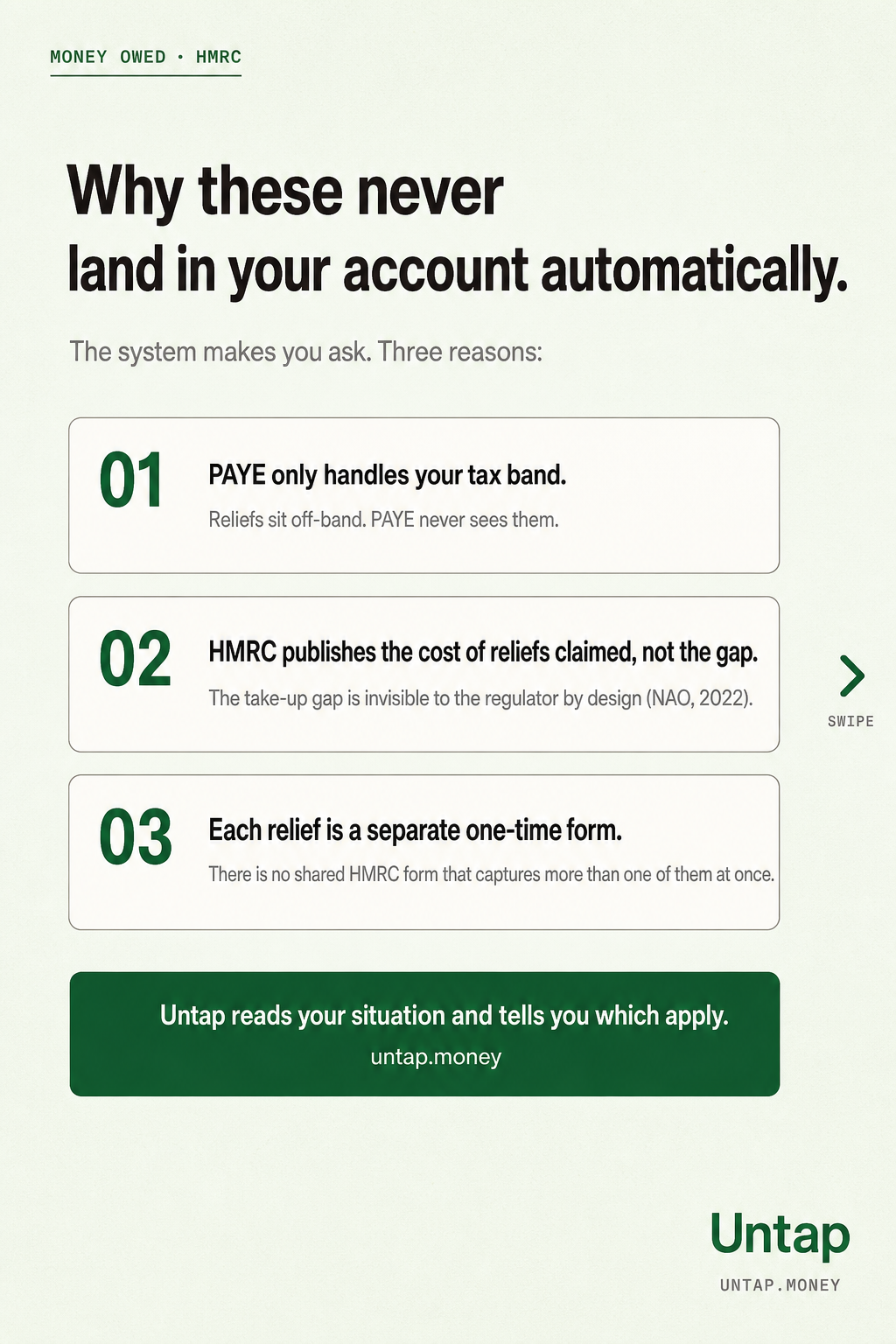
Each of the five has a separate route, and Untap finds the ones that apply to you
None of the five reliefs requires a tax return on its own, although the higher-rate pension top-up does if you don’t already file Self Assessment. The other four are short online or paper forms, free of charge:
- Marriage Allowance: apply at gov.uk/marriage-allowance. Five minutes online if you have both partners’ National Insurance numbers handy.
- Higher-rate pension top-up: through your Self Assessment return, or by writing to HMRC to ask for the extra relief if you don’t file Self Assessment. The same four-year backdate rule applies.
- Uniform tax relief: Form P87, or the new GOV.UK online flat-rate journey live since 31 October 2024.
- Professional subscriptions: Form P87 or your Self Assessment return.
- WFH (closing window): Form P87 or Self Assessment, before 5 April 2030 for tax years 2022-23 to 2025-26.
Untap reads your situation and tells you which apply. Forward the relevant context to your Untap inbox, or use the one-off wizard. We don’t file the claim. That part stays with you, on HMRC’s portal or your tax return.
The full how-to lives in our guides: Marriage Allowance, Working from Home tax relief, Uniform tax relief, and Professional Subscriptions.
Reproduce every figure in this piece
- HMRC Non-structural tax relief statistics, December 2024· Marriage Allowance claimant counts and £560m fiscal cost. Open
- House of Commons Library Briefing SN00870 (May 2025)· 4.2 million eligible couples; ~48% take-up. Read
- GOV.UK · Removal of tax relief on non-reimbursed homeworking expenses (policy paper)· WFH relief abolished from 6 April 2026; four-year backdate window remains. Read
- Corporate Adviser · LCP FOI on pension tax relief· ~880,000 higher-rate earners not claiming relief-at-source top-up; aggregate over £1bn/yr. Read
- HMRC Employment Income Manual EIM32712 + EIM32880· Flat Rate Expenses (uniform) and professional subscriptions relief. EIM32712 · EIM32880
- National Audit Office · The effective management of tax reliefs (August 2022)· The take-up gap is invisible to HMRC by design. Read
See if you are owed a rebate
Free with a sign-in, and we take no percentage. Backdating is where most of the money is, and we work that out too.
Money Owed · HMRC is the first instalment of Untap’s Money Owed series, a rolling field guide to UK consumer money sitting unclaimed. The £1.5 billion aggregate figure is a derivation from HMRC December 2024 statistics, the LCP FOI on pension top-up, and order-of- magnitude estimates for the smaller reliefs; it is labelled as such throughout. Comments and corrections to contact@untap.money.
Published 9 May 2026.
£1.5bnin HMRC reliefs unclaimed every year